
28 May - 20 June 2010
Pori, Finland
PORI ART MUSEUM;
PORIGINAL GALLERY SCULPTURE GARDEN,
AALTO UNIVERSITY / DEPARTMENT OF ART AND MEDIA PORI / OLD COTTON MILL, ART GENERATION SPACE, DYEHOUSE
29.5. -20.6. 2010
ULAANBAATAR MONGOLIA 2011
ARTISTS / ARCHITECTS:
GREGORY COWAN, AUS/GB
ALETTA DE JONG, NL
MICHAEL FÜRST, AUT
KATRIN HORNEK, AUT
SONIA LEIMER, ITA/AUT
CHRISITAN MAYER,GER/AUT
ANA REWAKOWICZ, PL/CAN
CHRISTINE SAALFELD, GER/NL
OULA SALOKANNEL, FIN
SER-ODIN DOLGOR, MN
SEDBAZARIN GANZUG, MN
TOGMIDSHIIREVIN ENKHBOLD, MN
ANNU WILENIUS,FIN
YO.DALKH-OCHIR, MN
AUTHORS:
B. DAAJAV, MN
GREGORY COWAN, AUS/GB
SAARA HACKLIN, FIN
TAINA RAJANTI, FIN
ANNU WILENIUS, FIN
Curator / Organiser: ANNU WILENIUS
Bare House Project looks into the possibilities of a personal relation to architecture in a world, which still mainly arranges life according to ideals inherited from modernist thinking. Also, the so called third world societies are being ”updated” to these ideals without much consideration of climate or cultural contexts of other kinds. Mongolia – where nomadism and soviet city planning is changing with disorganized ger districts and staggering tower blocks – functions as a reference point in the project, alongside the cities of Rotterdam and Pori.
Saturday, 22 May 2010


Monday, 22 February 2010
Adaptapartment, Coventry

The Independent Living model apartment with Eleanor Lisney is now complete, and features in this video: http://www.youtube.com/watch?v=rCsodgg0iKg
Saturday, 19 September 2009
Building
 After the experience of hands-on construction in Mongolia, where the architecture school to which I contributed marginally has now been sold on in light of the economic situation there, I now find myself supervising a construction site in Germany, as part of a project within a project. The general construction and tiling contractors nominated by our Berlin-based contacts do not seem to have much experience dealing with the fine italian glass mosaics we are using. We want to produce two beautifully but simply detailed model bathrooms in connection with our project for about 80 Loft Apartments in Frankfurt's East Harbour. Although detailed 1:20 drawings were provided, the workers need to be guided through the placement of the tiles, especially the need to begin tiling strategically by aligning the sheet edges in the most conspicuous places, so that any adjustments can be made unnoticeably in less prominent areas. The oversight of entire elements of the building planned -such as a bath podium discussed early in the construction - suggests that drawings alone are not enough, and the exercise of pencilling everything to be constructed onto the walls and floors becomes both meaningful and necessary.
Monday, 15 June 2009
Along The Great Wall
In late May, I presented a paper on developing architecture teaching in Ulaanbaatar at a conference on Architecture and Identity in China and Mongolia. I reflected on the methods of participation used in the development work in peri-urban Ulaanbaatar - sharing and workshopping some of the outcomes from the blog with UK students. Sheffield PhD researcher Supreeya Wunpatcharapon helped to compile the responses from the 'Lines of Flight' seminar, and these were presented at the conference. A shorter report is in preparation for the proceedings publication.
The conference was an excellent opportunity to meet with Purev-Erdene Ershuu and Gonchigbat, visiting from the Mongolian University of Science and Technology (MUST) and to be introduced to OTSCHIR, the Mongolia-Austria society there. It was an opportunity to work with colleagues and develop inspiration for projects like a book about the Mongolian city.
The conference was an excellent opportunity to meet with Purev-Erdene Ershuu and Gonchigbat, visiting from the Mongolian University of Science and Technology (MUST) and to be introduced to OTSCHIR, the Mongolia-Austria society there. It was an opportunity to work with colleagues and develop inspiration for projects like a book about the Mongolian city.
Sunday, 19 April 2009
Volunteer Sees Disunity Hampering Mongolia
Nickson Kakiri, my oft-mentioned VSO colleague and collaborator, who recently returned to Kenya, on the development work in Mongolia;
Volunteer Sees Disunity Hampering Mongolia's Disabled
William Kennedy, UB Post, Thursday, March 12, 2009.
Many obstacles stand between disabled people and a comfortable life in Mongolia, but one of the biggest may be a lack of cooperation between the various groups representing them. Recently, the aid organization Voluntary Service Overseas (VSO) arranged a meeting of several Disabled Persons Organizations (DPOs) in Ulaanbaatar’s Puma Hotel, with the express purpose of promoting exchange and collaboration. It’s a necessary step for groups of marginalized people hoping to advance their causes, according to Nickson Kakiri, a VSO volunteer working with Mongolia’s Federation of the Deaf as a Mainstreaming Disability Adviser.
“Organizations or individuals, if they don’t speak as a group, they’re not strong, “he said. “If they don’t involve other groups, they’re not as trusted.”
more..
Friday, 10 April 2009
wrc
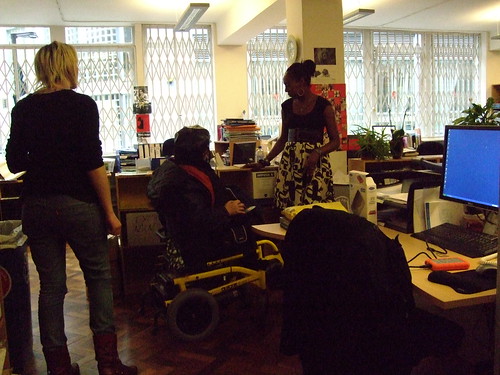 In April I accompanied Connect Culture's Eleanor Lisney on an access audit at the local Womens Resource Centre. The hard-to-find sign and step threshold at the building entrance were the first barriers, but internally, the ground level offices and toilets were relatively easily accessible. Some adaptations to improve the clarity for visual impaired people and deaf people were suggested, with some ideas about protocols and reception for people with diverse disabilities.
The completed report is available by request.
Friday, 3 April 2009
the girl in the café (film review)
I was delighted when the touring copy of this DVD arrived in the mail from the previous reviewer in Leuven, Belgium. When I booked in several months ago to see this film, I was aware that it portrayed some kind of unlikely chance meeting between two odd characters, played by Bill Nighy and Kelly MacDonald. I thought of 'Lost in Translation'. But little did I know how apt it would be, at this time and this week to see this film, as it tackles the themes of the G8 summit and the Millenium Development Goals, no less. The G20 meeting has just ended in London, with discussion of the IMF, rather than of the MDGs. The latter goals were the first ever theme of this blog, and something in which I have become increasingly interested, as a means to measure the overwhelming need to reduce poverty.
Richard Curtis' script for The Girl in the Cafe somehow connects this unlikely pair characters as a filmic device, which attempts optimistically to reconcile ordinary people with the decisions of world leaders. The press have not been feeling any such connection in London this week.
The film's settings are impressive, from the banal London Caff and Italian restaurant, to then later portraying modern architecture and urbanism in Rejkjavik. The moody photography of the city of Rejkjavik in changing light over the few days of the summit is very memorable. The luxury hotel accommodation for the summit, combined with the general reticence and conservatism of the world leaders at the summit, make a tense backdrop for Kelly MacDonald's character, an interloper, as she plays precariously on politicians' consciences.
The enjoyable pace of the film, and the sound track music by Sigur Ros and others, complete a watchable film with a strong positive message .
Subscribe to:
Posts (Atom)

