
There are a lot of buzzwords and shorthand terms especially in these planning policy debates. However a geographically localised approach seems to be needed, analysing and agreeing with local stakeholders on the basic principles for social and environmental sustainability of a neighbourhood. Seems good in theory; how will we take up these themes in architectural and planning education and in professional development?
Wednesday, 6 July 2011
Resilient Cities at WPSC
Resilience thinking: dramatically cutting carbon in the next decades and improving liveability - were themes of Peter Newman's presentation at the World Planning Schools Congress. Human place-based development of neighbourhoods, with sustainable densities, and balancing transport with (pedestrian) liveability, also involves reducing motor use. Scores of large cities in China and India currently building metro systems are cited as an example of a transformation towards transit oriented development. Resilience as a concept comes from a new urgency towards making sustainability principles practically feasible in a shorter term future.


Talking Streets at the WPSC
'People' and 'place identity' - these have been appeared often as themes in talks here at the World Planning Schools Congress in Perth. The session into which my presentation was allocated yesterday, Urban Landscape, Morphology and Industrial Heritage, was concerned with urban landscape as a 'memory carrier' (Andreas Wesener), as a site of urban rituals (Gabriella Quintana) and as a 'place', as a meaningful space in the perceptions of diverse street users (my own paper).
How do planners and urbanists extend the range of users with whom they work? Co-location and co-operation with these more diverse 'stakeholders' would be one way for urban researchers to better embed themselves in urban analysis of place. Quintana's work in a barrio with a Catholic priest who is respected by both criminal gangs and religious parade organisers suggests an intervening agent might help. Wesener's 'empirical' work on memory with J.P Thibaud's Parcours Commentee (2001) walking interview method could be considered alongside Kuninbach's (2003) Go Along method and Sarah Pink's video interviews (2007). I am interested in accessing 'hard to reach' stakeholders. Children using inner city mixed-use streets would be an example.
Felicity Morel-Ednie Brown today talked about the pre-capitalist city that was the basis of colonial Perth in 1829 (Williamsburg was the first and Perth the last colonial capitol city) and the current search for authenticity. William Street has become the gay and lesbian sector of Perth. The notion of authenticity is problematic authentic v pastiche - sense of home (naming Padbury walk as a reference to Mr Padbury was an example of pastiche - How can we understand London Court - or Hyde Park or Kings Park or 'Swan' River or 'Perth' for that matter as any more authentic?
Cliff Hague, who wrote Place Identity, Participation and Planning - noted in the session that place is contested, there are winners and losers. Political and Market forces constantly reshape places. A paper by Dave Hedgcock, comparing Italian and Australian planning education systems, pointed out that the Italian Urbanista role lacks the professional-political independence enjoyed by the Australian City Planner role. Perth has recently published a vision for 2031 (subsequent to Weller's book Boomtown 2020). "Perth is finally becoming a city", said Antony Ednie-Brown afterwards, in a passing comment.
Sunday, 8 May 2011
Occupying Streets @ StreetsMethodologies2011

Some sounds were recorded, notes and maps were made, and all of the resulting drawings, sounds and photographs were shared on Friday morning at the Slade.
See/listen also http://audioboo.fm/streetsatnight
UCL CitiesMethodologies2011
details (https://www.facebook.com/notes/gregory-cowan/24-hour-street-design-analysis-workshop-occupying-streets/10150218300975330)
Occupying Streets (updated 04.05.2011)
24 hour Street Design analysis workshop
Greg Cowan, assisted by Izis Salvador Pinto
Brief
>>10.00am Thursday 5 MayCitiesMethodologies2011: UCL Slade Research Centre, (Woburn Square, WC1H 0A)
Briefing: We go on a field work excursion to Caledonian Road, Kings Cross; 1 mile along Euston Road.
Complete worksheet, parts a/b/c/d at agreed time within 24 hrs
return by 10.00 on Friday 6 May / Pin up worksheets at Slade Research Centre Woburn Sq, compilation of findings and discussion with facilitators (online http://lnkd.in/7ptS3b)
Seminar
1.Briefing: Practical field work street appraisal exercise: observe, record and engage with the study area, testing a) analyse users, b) analyse building form and use, c) analyse permeability, and legibility (map)
consider drawn and three-dimensional modelled analyses, including scale analysis and use-coding.
TIMELINE: 11.00 ----16.00 --- 21.00 --- 01.00 --- 06.00
a/.USER ANALYSIS: shopper, worker, 'street population', commuter, child, visitor/tourist, etc
b/. BUILT FORM ANALYSIS
use – function (residential, entertainment etc)
form – age, height, style
legibility – what is it – can I find it? - is it useful to me?
permeability – can I get through – can I see in? – do I feel safe going in or through? - accessible along my way?
c/ MAPlocal observations
wider links
social and physical
transport issues
d/
SUGGESTIONS
W. H. Whyte suggested that by observing and by talking to people, we can learn a great deal about what people want in public spaces and can put this knowledge to work in creating places that shape liveable communities. We should therefore enter spaces without theoretical or aesthetic biases, and “look hard, with a clean, clear mind, and then look again – and believe what we see.” (pps.org)
>>10.00am Friday 6 May
Pin Up at Slade Research Centre Rm 5 or hand to GC
Further References
William Holly-White (1975) 'Street Life Project' in Ewing, McGowan, Speed & Bernie, eds (2010) Architecture and Field/Work 2010, p72 [see also http://www.pps.org/articles/wwhyte/ accessed 4 May 2011]
Peter Jones, Marion Roberts, Linda Morris 2007 'The contribution of local high streets to sustainable communities' JRF Joseph Rowntree Foundation [online] http://www.jrf.org.uk/publications/contribution-local-high-streets-sustainable-communities accessed 4 May 2011
Chartered Institute of Highways and Transportation 2010 'Manual for Streets 2; Wider Application of the Principles' http://www.tfl.gov.uk/corporate/modesoftransport/1638.aspx accessed 4 May 2011
Transport for London (nd) London Streets [online] http://www.tfl.gov.uk/corporate/modesoftransport/1638.aspx accessed 4 May 2011
Transport Advice Portal 2011 Vulnerable Road Users [online]: http://www.tap.iht.org/en/topic/vulnerable-road-users/pedestrians/pedestrian-audit/ accessed 4 May 2011
Public Realm Information and Advisory Network (2011) 5 Easy Wins [online] http://www.publicrealm.info/prian_toptips.html accessed 4 May 2011
English Heritage (2010) Street Clutter Audit [online] http://www.english-heritage.org.uk/professional/advice/advice-by-topic/planning-and-transport/streets-for-all/street-clutter-audit/ accessed 4 May 2011]
Street: Caledonian Road, Town: King’s Cross
Observe and note:
Who and what occupies the street
moving people and animals
stationary people and animals
moving vehicles
stationary vehicles
Street: Caledonian Road, King’s Cross
Buildings and Active Frontages / Activities
Footway sentient / inanimate occupations
Carriageway
people
motorised/unmotorised vehicles
nature
upload sounds: http://audioboo.fm/livingstreetskx
location ___ Caledonian Rd / __ cnr _________St.
comments
your rating ------secure/safe
your rating ------attractiveness
your rating ------usability/condition -
Suggestions – street improvements
notes
(use a separate sheet)
feedback on Methodology
(see also - http://architectswithoutborders.blogspot.com/)
(this note: http://www.facebook.com/notes/gregory-cowan/24-hour-street-design-analysis-workshop-
occupying-streets/10150218300975330)


24 hour Street Design analysis workshop
Greg Cowan, assisted by Izis Salvador Pinto
Brief
>>10.00am Thursday 5 MayCitiesMethodologies2011: UCL Slade Research Centre, (Woburn Square, WC1H 0A)
Briefing: We go on a field work excursion to Caledonian Road, Kings Cross; 1 mile along Euston Road.
Complete worksheet, parts a/b/c/d at agreed time within 24 hrs
return by 10.00 on Friday 6 May / Pin up worksheets at Slade Research Centre Woburn Sq, compilation of findings and discussion with facilitators (online http://lnkd.in/7ptS3b)
Seminar
1.Briefing: Practical field work street appraisal exercise: observe, record and engage with the study area, testing a) analyse users, b) analyse building form and use, c) analyse permeability, and legibility (map)
consider drawn and three-dimensional modelled analyses, including scale analysis and use-coding.
TIMELINE: 11.00 ----16.00 --- 21.00 --- 01.00 --- 06.00
a/.USER ANALYSIS: shopper, worker, 'street population', commuter, child, visitor/tourist, etc
b/. BUILT FORM ANALYSIS
use – function (residential, entertainment etc)
form – age, height, style
legibility – what is it – can I find it? - is it useful to me?
permeability – can I get through – can I see in? – do I feel safe going in or through? - accessible along my way?
c/ MAPlocal observations
wider links
social and physical
transport issues
d/
SUGGESTIONS
making street safer
more accessible
more enjoyable as a place W. H. Whyte suggested that by observing and by talking to people, we can learn a great deal about what people want in public spaces and can put this knowledge to work in creating places that shape liveable communities. We should therefore enter spaces without theoretical or aesthetic biases, and “look hard, with a clean, clear mind, and then look again – and believe what we see.” (pps.org)
>>10.00am Friday 6 May
Pin Up at Slade Research Centre Rm 5 or hand to GC
Further References
William Holly-White (1975) 'Street Life Project' in Ewing, McGowan, Speed & Bernie, eds (2010) Architecture and Field/Work 2010, p72 [see also http://www.pps.org/articles/wwhyte/ accessed 4 May 2011]
Peter Jones, Marion Roberts, Linda Morris 2007 'The contribution of local high streets to sustainable communities' JRF Joseph Rowntree Foundation [online] http://www.jrf.org.uk/publications/contribution-local-high-streets-sustainable-communities accessed 4 May 2011
Chartered Institute of Highways and Transportation 2010 'Manual for Streets 2; Wider Application of the Principles' http://www.tfl.gov.uk/corporate/modesoftransport/1638.aspx accessed 4 May 2011
Transport for London (nd) London Streets [online] http://www.tfl.gov.uk/corporate/modesoftransport/1638.aspx accessed 4 May 2011
Transport Advice Portal 2011 Vulnerable Road Users [online]: http://www.tap.iht.org/en/topic/vulnerable-road-users/pedestrians/pedestrian-audit/ accessed 4 May 2011
Public Realm Information and Advisory Network (2011) 5 Easy Wins [online] http://www.publicrealm.info/prian_toptips.html accessed 4 May 2011
English Heritage (2010) Street Clutter Audit [online] http://www.english-heritage.org.uk/professional/advice/advice-by-topic/planning-and-transport/streets-for-all/street-clutter-audit/ accessed 4 May 2011]
Street: Caledonian Road, Town: King’s Cross
Observe and note:
Who and what occupies the street
moving people and animals
stationary people and animals
moving vehicles
stationary vehicles
Street: Caledonian Road, King’s Cross
Buildings and Active Frontages / Activities
Footway sentient / inanimate occupations
Carriageway
people
motorised/unmotorised vehicles
nature
upload sounds: http://audioboo.fm/livingstreetskx
location ___ Caledonian Rd / __ cnr _________St.
comments
your rating ------secure/safe
your rating ------attractiveness
your rating ------usability/condition -
Suggestions – street improvements
notes
(use a separate sheet)
feedback on Methodology
(see also - http://architectswithoutborders.blogspot.com/)
(this note: http://www.facebook.com/notes/gregory-cowan/24-hour-street-design-analysis-workshop-
occupying-streets/10150218300975330)
Sin Map of Victorian London
1. Circus Road "Suspect Books beneath Floorboards"
7. Euston Road "Tableaux Vivants"
14. Willis's "Indelicacy in the Dancing"
35. Bow Street "Visitors.. often indulged with a lewd song or half-naked dance"
53. Rotten Row "the cream of the courtesans rode in their carriages"
1. Circus Road "Suspect Books beneath Floorboards"
7. Euston Road "Tableaux Vivants"
14. Willis's "Indelicacy in the Dancing"
35. Bow Street "Visitors.. often indulged with a lewd song or half-naked dance"
53. Rotten Row "the cream of the courtesans rode in their carriages"
pilot interviews
Participants K Stok, C-M Teon, C Naki, S Char, T Newl, Y-K Hin, L Chau, J Polv, R Sal Pin, abs M Whit, Y dl B
Participants K Stok, C-M Teon, C Naki, S Char, T Newl, Y-K Hin, L Chau, J Polv, R Sal Pin, abs M Whit, Y dl B
Friday, 15 April 2011
Occupying Streets, Workshop - CitiesMethodologies UCL 5 May 2011
Occupying Streets
24 hour Street Design analysis workshop
Greg Cowan, assisted by Izis Salvador Pinto
Brief
>>10.00am Thursday 5 May
CitiesMethodologies2011: UCL Slade Research Centre, (Woburn Square, WC1H 0A)
Seminar
1.Briefing: Practical field work street appraisal exercise: observe, record and engage with the study area, testing a) analyse users, b) analyse building form and use, c) analyse permeability, and legibility (map)
consider drawn and three-dimensional modelled analyses, including scale analysis and use-coding.
TIMELINE: 11.00 ----16.00 --- 21.00 --- 01.00 --- 06.00
a/.USER ANALYSIS: shopper, worker, 'street population', commuter, child, visitor/tourist, etc
b/. BUILT FORM ANALYSIS
use – function (residential, entertainment etc)
form – age, height, style
legibility – what is it – can I find it? - is it useful to me?
permeability – can I get through – can I see in? – do I feel safe going in or through? - accessible along my way?
c/ MAP
local observations
wider links
social and physical
transport issues
d/ SUGGESTIONS
making street safer
more accessible
more enjoyable as a place
W. H. Whyte suggested that by observing and by talking to people, we can learn a great deal about what people want in public spaces and can put this knowledge to work in creating places that shape liveable communities. We should therefore enter spaces without theoretical or aesthetic biases, and “look hard, with a clean, clear mind, and then look again – and believe what we see.” (pps.org)
>>10.00am Friday 6 May
Pin Up at Slade Research Centre Rm 5 or hand to GC
Further References
William Holly-White (1975) 'Street Life Project' in Ewing, McGowan, Speed & Bernie, eds (2010) Architecture and Field/Work 2010, p72 [see also http://www.pps.org/articles/wwhyte/ accessed 4 May 2011]
Peter Jones, Marion Roberts, Linda Morris 2007
'The contribution of local high streets to sustainable communities' JRF Joseph Rowntree Foundation
[online] http://www.jrf.org.uk/publications/contribution-local-high-streets-sustainable-communities accessed 4 May 2011
Chartered Institute of Highways and Transportation 2010 'Manual for Streets 2; Wider Application of the Principles' http://www.tfl.gov.uk/corporate/modesoftransport/1638.aspx accessed 4 May 2011
Transport for London (nd) London Streets [online] http://www.tfl.gov.uk/corporate/modesoftransport/1638.aspx accessed 4 May 2011
Transport Advice Portal 2011 Vulnerable Road Users [online]: http://www.tap.iht.org/en/topic/vulnerable-road-users/pedestrians/pedestrian-audit/ accessed 4 May 2011
Public Realm Information and Advisory Network (2011) 5 Easy Wins [online] http://www.publicrealm.info/prian_toptips.html accessed 4 May 2011
English Heritage (2010) Street Clutter Audit
[online] http://www.english-heritage.org.uk/professional/advice/advice-by-topic/planning-and-transport/streets-for-all/street-clutter-audit/ accessed 4 May 2011]
Participant list
Mariana Whitehouse
Yolanda de los Bueis
Kathleen Stokes
Cherng-Min Teong
Carin Nakinishi
Sid Charity
Tobias Newland
Yin-King Hai
Lisa Chau
Jan Polverini
Rita Salvador Pinto
above note: http://www.facebook.com/notes/gregory-cowan/24-hour-street-design-analysis-workshop-occupying-streets/10150218300975330
24 hour Street Design analysis workshop
Greg Cowan, assisted by Izis Salvador Pinto
Brief
>>10.00am Thursday 5 May
CitiesMethodologies2011: UCL Slade Research Centre, (Woburn Square, WC1H 0A)
Briefing: We go on a field work excursion to Caledonian Road, Kings Cross; 1 mile along Euston Road.
Complete worksheet, parts a/b/c/d at agreed time within 24 hrs
return by 10.00 on Friday 6 May / Pin up worksheets at Slade Research Centre Woburn Sq, compilation of findings and discussion with facilitators (online http://lnkd.in/7ptS3b)
Complete worksheet, parts a/b/c/d at agreed time within 24 hrs
return by 10.00 on Friday 6 May / Pin up worksheets at Slade Research Centre Woburn Sq, compilation of findings and discussion with facilitators (online http://lnkd.in/7ptS3b)
Seminar
1.Briefing: Practical field work street appraisal exercise: observe, record and engage with the study area, testing a) analyse users, b) analyse building form and use, c) analyse permeability, and legibility (map)
consider drawn and three-dimensional modelled analyses, including scale analysis and use-coding.
TIMELINE: 11.00 ----16.00 --- 21.00 --- 01.00 --- 06.00
a/.USER ANALYSIS: shopper, worker, 'street population', commuter, child, visitor/tourist, etc
b/. BUILT FORM ANALYSIS
use – function (residential, entertainment etc)
form – age, height, style
legibility – what is it – can I find it? - is it useful to me?
permeability – can I get through – can I see in? – do I feel safe going in or through? - accessible along my way?
c/ MAP
local observations
wider links
social and physical
transport issues
d/ SUGGESTIONS
making street safer
more accessible
more enjoyable as a place
W. H. Whyte suggested that by observing and by talking to people, we can learn a great deal about what people want in public spaces and can put this knowledge to work in creating places that shape liveable communities. We should therefore enter spaces without theoretical or aesthetic biases, and “look hard, with a clean, clear mind, and then look again – and believe what we see.” (pps.org)
>>10.00am Friday 6 May
Pin Up at Slade Research Centre Rm 5 or hand to GC
Further References
William Holly-White (1975) 'Street Life Project' in Ewing, McGowan, Speed & Bernie, eds (2010) Architecture and Field/Work 2010, p72 [see also http://www.pps.org/articles/wwhyte/ accessed 4 May 2011]
Peter Jones, Marion Roberts, Linda Morris 2007
'The contribution of local high streets to sustainable communities' JRF Joseph Rowntree Foundation
[online] http://www.jrf.org.uk/publications/contribution-local-high-streets-sustainable-communities accessed 4 May 2011
Chartered Institute of Highways and Transportation 2010 'Manual for Streets 2; Wider Application of the Principles' http://www.tfl.gov.uk/corporate/modesoftransport/1638.aspx accessed 4 May 2011
Transport for London (nd) London Streets [online] http://www.tfl.gov.uk/corporate/modesoftransport/1638.aspx accessed 4 May 2011
Transport Advice Portal 2011 Vulnerable Road Users [online]: http://www.tap.iht.org/en/topic/vulnerable-road-users/pedestrians/pedestrian-audit/ accessed 4 May 2011
Public Realm Information and Advisory Network (2011) 5 Easy Wins [online] http://www.publicrealm.info/prian_toptips.html accessed 4 May 2011
English Heritage (2010) Street Clutter Audit
[online] http://www.english-heritage.org.uk/professional/advice/advice-by-topic/planning-and-transport/streets-for-all/street-clutter-audit/ accessed 4 May 2011]
Participant list
Mariana Whitehouse
Yolanda de los Bueis
Kathleen Stokes
Cherng-Min Teong
Carin Nakinishi
Sid Charity
Tobias Newland
Yin-King Hai
Lisa Chau
Jan Polverini
Rita Salvador Pinto
above note: http://www.facebook.com/notes/gregory-cowan/24-hour-street-design-analysis-workshop-occupying-streets/10150218300975330
Biographical statement of contributor(s) including UCL or other affiliation (max. 100 words).
Gregory Cowan
(University of Westminster)
I am a researcher, educator and consultant in architecture, urban design and regeneration. Based in London, UK, I am analysing users, space and movement in city streets and their roles in street design. I also work in architecture and design education, including professional development education for architects.
My research on urban regeneration and streets is aimed at understanding inner cities in Europe and regenerating areas near transport hubs. I am seeking improvements to development of shared urban space through design, education and communication; with the aims of producing attractive, accessible and sustainable urban spaces, streets, and architecture.
Co-facilitators / Assistants
Izis Salvador Pinto
http://www.westminster.ac.uk/schools/architecture/research/research-students/izis-salvador-pinto
Liaison / Coordination Cities Methodologies Ben Campkin
http://www.ucl.ac.uk/citycentre/people/bencampkin

more about:
CITIESMETHODOLOGIES 2011
ABOUT:Inaugurated in 2009, CitiesMethodologies showcases innovative methods in urban research.
Visitors to Cities Methodologies encounter diverse methods of urban research in juxtaposition - from archival studies to statistical analyses, practice-led art, architectural and design work to oral history, writing, walking, performances, film-making and photography.
Cities Methodologies promotes cross- and inter-disciplinary work, and showcases recent research on a wide range of cities.
Participants are drawn from right across UCL, as well as from De Montfort University, CUNY, University of Edinburgh, Goldsmiths, Harvard Graduate School of Design, Humboldt Universität Berlin, LSE, University of Manchester, National University of the Arts, Bucharest, Queen Mary’s University of London, and the University of Westminster.
EXHIBITION AND EVENTS: 4 to 7 May 2011
Weds 4 May, 18.30 to 21.00
Thurs 5 May, 10.00 to 20.00
Friday 6 May, 10.00 to 20.00
Saturday 7 May, 10.00-13.00
Venue: Slade Research Centre, Woburn Square, London, WC1H 0AB.
All events are free. No booking required except where stated.
Programme updates: http://www.ucl.ac.uk/urbanlab/en2/index.php?page=3.0.0
Enquiries to Fusun Turetken
Supported by:
UCL Urban Laboratory
UCL Bartlett Faculty of the Built Environment
UCL Slade School of Fine Art
UCL School of Slavonic and East European Studies
Curated and organised by:
Dr Ben Campkin, UCL Urban Laboratory/Bartlett School of Architecture
Dr Susan Collins, UCL Slade School of Fine Art
Dr Ger Duijzings, UCL School of Slavonic & East European Studies
Prof Jane Rendell, UCL Bartlett Faculty of the Built Environment
Füsun Türetken, UCL Urban Laboratory/PhD Candidate Goldsmiths
Launch, 18.30, Wednesday 4 May 2011.
Performance by T.R.I.P.O.D.
Exhibits
Nana Adusei-Poku and Füsun Türetken, No Name in the Street
Ximena Alarcón, Sounding Underground
Yun Jie Chung and Brent Pilkey, Do Ho Suh’s ‘The Bridge Project’
Inês Dantas, Wohnwald: Inhabitable Urban Forest
Carolyn Deby, citysited/1
Ming Deng, Jacob Wilson and Mayuri Sisodia, Orhan in the City
Teresa de Macedo, Dual Archaeology
Max Dewdney, Chiaroscuro City
Oliver Gregory, Lucia Caistor, Samira Islam, Matthew Wright, The Heygate
Mohamad Hafeda, Sewing Sound
Suzanne Hall and Juliet Davis and others, City Street
Benjamin Holzman, Hold My Hand
Tom Jenkins, The City
SubREAL, Interviewing the Cities
Iosif Kiraly and others, Ro-Archive
Mircea Nicolae, Glass Globes / 25 Demolished Houses
Benjamin Leclair-Paquet, West Bank Lab: Military Urbanism and Border Bending
Manu Luksch, Mapping CCTV around Whitehall and Blue-sky Blueprint
Hilary Powell, Structures of Enchantment: Pop-Up Books in/on progress
Sophia Psarra, Detroit: the Fall of the Public Realm
Bradley L. Garrett, Jonathan Prior and Brian Rosa, Jute
Seijin Kim, Hana_Set
Maria Sfaellou, London - the City of Senses
Simson&Volley, Project Project, Protest!
Dorian Wiszniewski and others, Florence: Curating The City.
[http://www.ucl.ac.uk/urbanlab/en2/index.php?page=1.3.0&getlistarticle=118&listrange=current ]


Friday, 5 November 2010
London and Frankfurt
Kings Cross (KX LON) and Bahnhofsviertel (BV FFT)
Two central urban regeneration areas with colour, diversity, complexity and 24 hour cultures, where developments in the twenty-first century will be borne out in the changing 'conviviality' of streets like Caledonian Road (KX) and Niddastrasse (BV)...
Kings Cross

http://www.kingscrossaccess.com/2009/03/chaos-and-complexity-rules-for-traffic-in-kings-cross-1.html
Bahnhofsviertel
clip: http://www.frankfurt.de/sixcms/detail.php?id=2738&_ffmpar[_id_inhalt]=7411560
Wolfgang Lenz (Master shoemaker, Schuhmachermeister Lenz)
Anette Rack (Jewelery Designer)
Klaus-Peter Kemper (Stadtteilbuero, Moselstrasse)
Dominik Bade Physics student and musician (Free rehearsal space, Hotel 25hrs Niddastrasse)
Two central urban regeneration areas with colour, diversity, complexity and 24 hour cultures, where developments in the twenty-first century will be borne out in the changing 'conviviality' of streets like Caledonian Road (KX) and Niddastrasse (BV)...
Kings Cross

http://www.kingscrossaccess.com/2009/03/chaos-and-complexity-rules-for-traffic-in-kings-cross-1.html
Bahnhofsviertel

clip: http://www.frankfurt.de/sixcms/detail.php?id=2738&_ffmpar[_id_inhalt]=7411560
Wolfgang Lenz (Master shoemaker, Schuhmachermeister Lenz)
Anette Rack (Jewelery Designer)
Klaus-Peter Kemper (Stadtteilbuero, Moselstrasse)
Dominik Bade Physics student and musician (Free rehearsal space, Hotel 25hrs Niddastrasse)
Monday, 9 August 2010
Regeneration by Micronomics - CityMine(d)
Micronomics_Unvermittelt_08
Uploaded by micronomics. - News videos from around the world.
Local people leading processes of urban regeneration - some organisations and their methods presented by CityMine(d)
In this video, groups and activists including 'Media Spree Versenken' (Sink Media Spree, Berlin) explain how they are working on urban regeneration; for example to replace the (Media Spree-driven form of) 'city planning' and to enable a better built - and also non-built - set of uses for the Spree River area. (About Sink Media Spree)
Kings Cross residents are currently discussing what could be done with this troubled central London area (map) to make it work - is it all to be left to Transport for London and the Railway companies?
please comment!
Thursday, 29 July 2010
Careers across borders
Recent graduate Zaira Iudice found the architects without borders discussion page on facebook and was looking for entry points into architectural humanitarian work.
I introduced her to the Humanitarian Information Pack, an extensive working guide which I initially developed with a practitioner Elizabeth Babister when I was at RIBA Education, and which is now maintained by Article 25.
It outlines major players in the disaster recovery and international development field and provides many contacts and websites to enable those with interest and passion for emergency relief and development architecture to become more active.
Saturday, 22 May 2010
Bare House
28 May - 20 June 2010
Pori, Finland
PORI ART MUSEUM;
PORIGINAL GALLERY SCULPTURE GARDEN,
AALTO UNIVERSITY / DEPARTMENT OF ART AND MEDIA PORI / OLD COTTON MILL, ART GENERATION SPACE, DYEHOUSE
29.5. -20.6. 2010
ULAANBAATAR MONGOLIA 2011
ARTISTS / ARCHITECTS:
GREGORY COWAN, AUS/GB
ALETTA DE JONG, NL
MICHAEL FÜRST, AUT
KATRIN HORNEK, AUT
SONIA LEIMER, ITA/AUT
CHRISITAN MAYER,GER/AUT
ANA REWAKOWICZ, PL/CAN
CHRISTINE SAALFELD, GER/NL
OULA SALOKANNEL, FIN
SER-ODIN DOLGOR, MN
SEDBAZARIN GANZUG, MN
TOGMIDSHIIREVIN ENKHBOLD, MN
ANNU WILENIUS,FIN
YO.DALKH-OCHIR, MN
AUTHORS:
B. DAAJAV, MN
GREGORY COWAN, AUS/GB
SAARA HACKLIN, FIN
TAINA RAJANTI, FIN
ANNU WILENIUS, FIN
Curator / Organiser: ANNU WILENIUS
Bare House Project looks into the possibilities of a personal relation to architecture in a world, which still mainly arranges life according to ideals inherited from modernist thinking. Also, the so called third world societies are being ”updated” to these ideals without much consideration of climate or cultural contexts of other kinds. Mongolia – where nomadism and soviet city planning is changing with disorganized ger districts and staggering tower blocks – functions as a reference point in the project, alongside the cities of Rotterdam and Pori.
Monday, 22 February 2010
Adaptapartment, Coventry

The Independent Living model apartment with Eleanor Lisney is now complete, and features in this video: http://www.youtube.com/watch?v=rCsodgg0iKg
Saturday, 19 September 2009
Building
 After the experience of hands-on construction in Mongolia, where the architecture school to which I contributed marginally has now been sold on in light of the economic situation there, I now find myself supervising a construction site in Germany, as part of a project within a project. The general construction and tiling contractors nominated by our Berlin-based contacts do not seem to have much experience dealing with the fine italian glass mosaics we are using. We want to produce two beautifully but simply detailed model bathrooms in connection with our project for about 80 Loft Apartments in Frankfurt's East Harbour. Although detailed 1:20 drawings were provided, the workers need to be guided through the placement of the tiles, especially the need to begin tiling strategically by aligning the sheet edges in the most conspicuous places, so that any adjustments can be made unnoticeably in less prominent areas. The oversight of entire elements of the building planned -such as a bath podium discussed early in the construction - suggests that drawings alone are not enough, and the exercise of pencilling everything to be constructed onto the walls and floors becomes both meaningful and necessary.
Monday, 15 June 2009
Along The Great Wall
In late May, I presented a paper on developing architecture teaching in Ulaanbaatar at a conference on Architecture and Identity in China and Mongolia. I reflected on the methods of participation used in the development work in peri-urban Ulaanbaatar - sharing and workshopping some of the outcomes from the blog with UK students. Sheffield PhD researcher Supreeya Wunpatcharapon helped to compile the responses from the 'Lines of Flight' seminar, and these were presented at the conference. A shorter report is in preparation for the proceedings publication.
The conference was an excellent opportunity to meet with Purev-Erdene Ershuu and Gonchigbat, visiting from the Mongolian University of Science and Technology (MUST) and to be introduced to OTSCHIR, the Mongolia-Austria society there. It was an opportunity to work with colleagues and develop inspiration for projects like a book about the Mongolian city.
The conference was an excellent opportunity to meet with Purev-Erdene Ershuu and Gonchigbat, visiting from the Mongolian University of Science and Technology (MUST) and to be introduced to OTSCHIR, the Mongolia-Austria society there. It was an opportunity to work with colleagues and develop inspiration for projects like a book about the Mongolian city.
Sunday, 19 April 2009
Volunteer Sees Disunity Hampering Mongolia
Nickson Kakiri, my oft-mentioned VSO colleague and collaborator, who recently returned to Kenya, on the development work in Mongolia;
Volunteer Sees Disunity Hampering Mongolia's Disabled
William Kennedy, UB Post, Thursday, March 12, 2009.
Many obstacles stand between disabled people and a comfortable life in Mongolia, but one of the biggest may be a lack of cooperation between the various groups representing them. Recently, the aid organization Voluntary Service Overseas (VSO) arranged a meeting of several Disabled Persons Organizations (DPOs) in Ulaanbaatar’s Puma Hotel, with the express purpose of promoting exchange and collaboration. It’s a necessary step for groups of marginalized people hoping to advance their causes, according to Nickson Kakiri, a VSO volunteer working with Mongolia’s Federation of the Deaf as a Mainstreaming Disability Adviser.
“Organizations or individuals, if they don’t speak as a group, they’re not strong, “he said. “If they don’t involve other groups, they’re not as trusted.”
more..
Friday, 10 April 2009
wrc
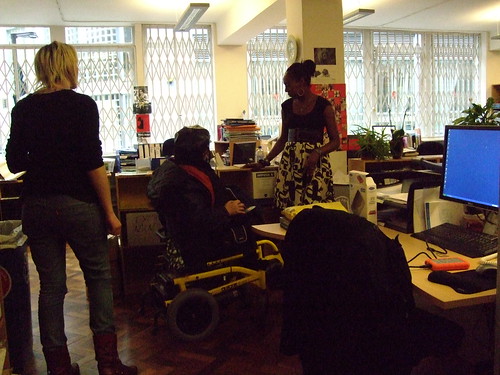 In April I accompanied Connect Culture's Eleanor Lisney on an access audit at the local Womens Resource Centre. The hard-to-find sign and step threshold at the building entrance were the first barriers, but internally, the ground level offices and toilets were relatively easily accessible. Some adaptations to improve the clarity for visual impaired people and deaf people were suggested, with some ideas about protocols and reception for people with diverse disabilities.
The completed report is available by request.
Friday, 3 April 2009
the girl in the café (film review)
I was delighted when the touring copy of this DVD arrived in the mail from the previous reviewer in Leuven, Belgium. When I booked in several months ago to see this film, I was aware that it portrayed some kind of unlikely chance meeting between two odd characters, played by Bill Nighy and Kelly MacDonald. I thought of 'Lost in Translation'. But little did I know how apt it would be, at this time and this week to see this film, as it tackles the themes of the G8 summit and the Millenium Development Goals, no less. The G20 meeting has just ended in London, with discussion of the IMF, rather than of the MDGs. The latter goals were the first ever theme of this blog, and something in which I have become increasingly interested, as a means to measure the overwhelming need to reduce poverty.
Richard Curtis' script for The Girl in the Cafe somehow connects this unlikely pair characters as a filmic device, which attempts optimistically to reconcile ordinary people with the decisions of world leaders. The press have not been feeling any such connection in London this week.
The film's settings are impressive, from the banal London Caff and Italian restaurant, to then later portraying modern architecture and urbanism in Rejkjavik. The moody photography of the city of Rejkjavik in changing light over the few days of the summit is very memorable. The luxury hotel accommodation for the summit, combined with the general reticence and conservatism of the world leaders at the summit, make a tense backdrop for Kelly MacDonald's character, an interloper, as she plays precariously on politicians' consciences.
The enjoyable pace of the film, and the sound track music by Sigur Ros and others, complete a watchable film with a strong positive message .
Friday, 20 March 2009
Olympic Cauldron
 The 'temporary' Olympics Stadium design for London 2012, is neither very cheap nor recyclable, according to critique. The Architects' Journal has highlighted the Stadium's spurious temporality, sustainability and flexibility.
At a recent Newham mentoring launch event, I saw a presentation of the stadium project by Jeremy Harmsworth from McAlpine construction, suggesting that a large proportion of seating could be removed after the event - but the elaborate roof would remain, and the toilet and waste systems seemed conventional. 'Building the Dream' this week on the BBC gave an account of the politically sensitive background to the project. Meanwhile in East London, at last week's activity with teenage construction diploma students, we prototyped a structure to carry the cauldron.
CABE Review Finch AJ
The Games
Thursday, 26 February 2009
Fleet footed
 Inspired by walking and accessibility in the locale, and with a new interest in Living Streets and eco-hydrology, I was searching for information about the path of the River Fleet which runs somewhere beneath London next to my flat.
The excerpt from Homann's map of circa 1705 shows the Fleet running past where I sit, at that time in a field, and St Chad's Well must have been nearby, where now there is a café. Here, in 1772, a thousand people were reported to have 'drunk the waters' in a week.
I am planning a walk on 26 April, to remember Mary Wollstonecraft and to contemplate the underground Fleet (and personally perhaps even to remember the Derbal Yerrigan, the Danube, the Mur and the Tuul) in the wider context of River//Cities.
Saturday, 14 February 2009
connect culture Kings Cross
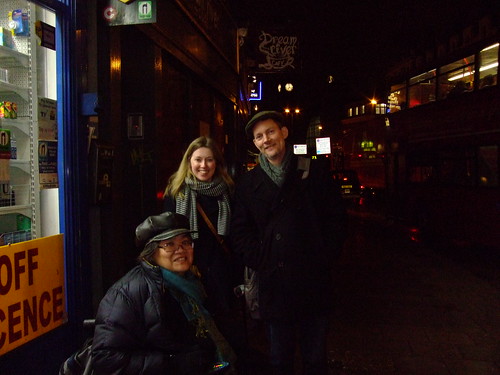
 Eleanor Lisney of Connect Culture, Denise Stephens of Enabled by Design, and I met to review Eleanor's Beauchamp House independent apartment living project. We discussed adaptible live-work spaces, kitchens and thresholds, and more specifically, processes of developing a design brief and work contract, and working with building contractors, among other topics.
After meeting at the Travelodge, we visited my own first floor flat, and although we found it partly wheelchair accessible, the WC is not. Most of the Euston Road restaurants and cafés between Birkenhead and St Chad Streets, where we considered eating, were barred, with 150mm high steps at the entrances - the only exception was a kebab shop.
follow the apartment project here
more on accessibility on Tour Watch
Wednesday, 11 February 2009
Rapid Urbanisation
 After reading about work on urbanisation in the city of Lodz (Malgorzata Hanzl et al), I am encouraged to extend my researches on peri-urbanism in Ulaanbaatar. While Lodz, as part of Europe, appears likely to enjoy a higher level of investment than Ulaanbaatar, students there also have an understanding of European urban architectures and master-planning which might not be appropriate in rapidly urbanising Mongolia.
I spoke to Monika Dzięgielewska-Geitz in Lodz in February, and learned about her work with cultural creatives and the 'restoration economy'. Monika's recent work with eco-hydrology in urban regeneration inspired me to think of the River Fleet and its place in the River//Cities network, which connects with some of my current ideas for an ecological history walk in Kings Cross, and perhaps one day in Ulaanbaatar.
Tuesday, 3 February 2009
connect culture

 I travelled to Coventry to measure and assess a dwelling, with connect culture's Eleanor Lisney, so that we can consider its adaptation for independent living. We reviewed thresholds, such as to the balcony, the kitchen, living room and the ensuite bathroom to the main bedroom.
The ensuite would be opened up as a wet room. The kitchen and main living area seem to have good potential as ann entertaining area. One idea - to make the balcony more accessible - was to raise the floor level inside. We also looked at ready-made furniture options nearby, at the only city centre Ikea store I have seen.
Sunday, 1 February 2009
Mobility
Having just returned from Euston railway station on a bicycle errand this morning, I was listening to BBC's Bicycle Diaries. Episode two is about livelihoods generated from bicycles in Kampala. One man was using bicycle parts to build wheelchairs, (like Amarbat) which the programme says, are in great demand there. (Negus 2004) Another man had a mobile telephone stall, another an icecream and groundnut business, each mounted on converted bicycles or tricycles.
It reminded me of our family's Christmas gift support to Re-cycle: Bicycle Aid, an organisation working with bicycle ambulances, -deliveries, -school runs and other grass-roots transport development through 'bicycle aid' in Africa. Other episodes of the BBC programme cover Parisian shared bicyles (1) and newspaper delivery cycles in Delhi (3), the latter reminded me of my past jobs. Another BBC programme covers the decline in work for London's cycle couriers.
bicycle-wheelchair tandem
folding wheel
Subscribe to:
Posts (Atom)

